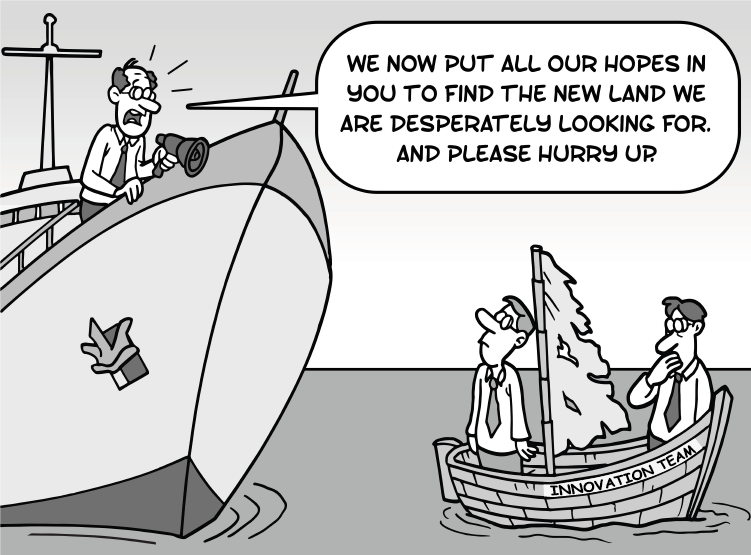
Nothing new that resource-wise innovation projects are always in daily competition with operations in the core business. But often the situation is rather like „In two years from now we expect to generate 10M € of revenues with new business models. That`s why we invest in two employees to work part-time on achieving this goal.“
Now, how realistic is it that 2 people can facilitate this, no matter how motivated and smart they are? If this was realistic, any Start-up (e.g. 20 people working 150% for 3 yrs to achieve this range of revenues) would be doing something horribly wrong.
Most likely a lack of understanding what it takes to develop new business.
It happens that growth expectations from scaling core business are transferred to exploring new business. Even though these two tasks cannot be more different regarding approach, required skills and challenges. When scaling, the business itself is proven already. There`s no need to first identify, then understand a new target group very well to then at all be able to develop and test new kinds of offerings and business models for which most likely new channels have to be tested. Not even taking into account the hurdles that often have to be overcome when trying to develop new business within an existing organisation.
Coach - Helping the Top Mgmt understand the very specific coherences of innovation work and what can be expected in relation to resources. And working closely together with the Top Mgmt to define objectives and a feasible way to reach these. Who could better manage expectations regarding innovation efforts and the necessary conditions than the innovation manager?
Consequent Manager in Charge - Being very precise in defining frame conditions and being consequent in not taking responsibility to reach goals if adequate frame conditions are not provided. It happens all too often that innovation managers find themselves fighting a battle they cannot win.
Partner - Working closely together with the InnoMgmt to jointly define goals and prerequisites for innovation.
Enabler - Giving the innovation manager psychological safety by encouraging that he/she is the one with the most expertise in the company in terms of coherences and the approach to innovation. If there are any doubts, take steps to help the employee settle into their role.
It feels like a pain in the butt but we should take the time and get very precise when defining the prerequisites for successful work. In the end we are measured by success. Saying in hindsight, “Well, it couldn't have worked under those circumstances,” doesn't help anyone. Instead, it erodes trust.
________________________________________
The project has startet with all the manpower needed. But then it starts to show that increasingly tasks are not worked on. "There are some urgent topics popping up in our other project. But we'll manage somehow to keep the innovation project going."
Even if sufficient manpower is provided at the beginning of an innovation project, it often happens that team members have to take on other tasks in day-to-day operations at short notice. The innovation team can no longer deliver the desired output, no matter how motivated and willing to work overtime. This kind of silent death of an innovation project is very common.
Moderator - Understanding the individual motivations of the individual stakeholders (team members, coaches, project sponsors) and moderate to work out a way how to proceed. Putting a project on hold due to resource constraints is a responsible course of action and also has its positive aspects. It shows that the innovation team, sponsor, coach and innovation management are taking it serious to deliver the results initially agreed on. It values the time and effort of team members by not wasting them. And by putting innovation work on hold we circumvent the risk of burning the reputation of innovation initiatives in the company by not delivering sufficient output.
Consequent Manager - Identifying these correlations and weighing them. Being consequent and direkt in communication and in finding a way to ensure relevant project output or putting the project on hold. Anything else is likely to lead to reputation loss of innovation management and the whole initiative.
We have to make a personal decision here. How important is it to me that this innovation project is successful? (Note: It should be defined in the general framework for corporate innovation work what a successful innovation project is). Many questions arise. Am I willing to take the risk that a mediocre project result might reflect negatively on me in my function? What, exactly, is my overall responsibility? Simply run some projects vs. ensure output vs enhance the organization’s capability to innovate?
Nothing new that resource-wise innovation projects are always in daily competition with operations in the core business. But often the situation is rather like „In two years from now we expect to generate 10M € of revenues with new business models. That`s why we invest in two employees to work part-time on achieving this goal.“
Now, how realistic is it that 2 people can facilitate this, no matter how motivated and smart they are? If this was realistic, any Start-up (e.g. 20 people working 150% for 3 yrs to achieve this range of revenues) would be doing something horribly wrong.
Most likely a lack of understanding what it takes to develop new business.
It happens that growth expectations from scaling core business are transferred to exploring new business. Even though these two tasks cannot be more different regarding approach, required skills and challenges. When scaling, the business itself is proven already. There`s no need to first identify, then understand a new target group very well to then at all be able to develop and test new kinds of offerings and business models for which most likely new channels have to be tested. Not even taking into account the hurdles that often have to be overcome when trying to develop new business within an existing organisation.
Coach - Helping the Top Mgmt understand the very specific coherences of innovation work and what can be expected in relation to resources. And working closely together with the Top Mgmt to define objectives and a feasible way to reach these. Who could better manage expectations regarding innovation efforts and the necessary conditions than the innovation manager?
Consequent Manager in Charge - Being very precise in defining frame conditions and being consequent in not taking responsibility to reach goals if adequate frame conditions are not provided. It happens all too often that innovation managers find themselves fighting a battle they cannot win.
Partner - Working closely together with the InnoMgmt to jointly define goals and prerequisites for innovation.
Enabler - Giving the innovation manager psychological safety by encouraging that he/she is the one with the most expertise in the company in terms of coherences and the approach to innovation. If there are any doubts, take steps to help the employee settle into their role.
It feels like a pain in the butt but we should take the time and get very precise when defining the prerequisites for successful work. In the end we are measured by success. Saying in hindsight, “Well, it couldn't have worked under those circumstances,” doesn't help anyone. Instead, it erodes trust.
________________________________________
The project has startet with all the manpower needed. But then it starts to show that increasingly tasks are not worked on. "There are some urgent topics popping up in our other project. But we'll manage somehow to keep the innovation project going."
Even if sufficient manpower is provided at the beginning of an innovation project, it often happens that team members have to take on other tasks in day-to-day operations at short notice. The innovation team can no longer deliver the desired output, no matter how motivated and willing to work overtime. This kind of silent death of an innovation project is very common.
Moderator - Understanding the individual motivations of the individual stakeholders (team members, coaches, project sponsors) and moderate to work out a way how to proceed. Putting a project on hold due to resource constraints is a responsible course of action and also has its positive aspects. It shows that the innovation team, sponsor, coach and innovation management are taking it serious to deliver the results initially agreed on. It values the time and effort of team members by not wasting them. And by putting innovation work on hold we circumvent the risk of burning the reputation of innovation initiatives in the company by not delivering sufficient output.
Consequent Manager - Identifying these correlations and weighing them. Being consequent and direkt in communication and in finding a way to ensure relevant project output or putting the project on hold. Anything else is likely to lead to reputation loss of innovation management and the whole initiative.
We have to make a personal decision here. How important is it to me that this innovation project is successful? (Note: It should be defined in the general framework for corporate innovation work what a successful innovation project is). Many questions arise. Am I willing to take the risk that a mediocre project result might reflect negatively on me in my function? What, exactly, is my overall responsibility? Simply run some projects vs. ensure output vs enhance the organization’s capability to innovate?